Farm where you are....

Monday, June 21, 2010

Strawberry summer...

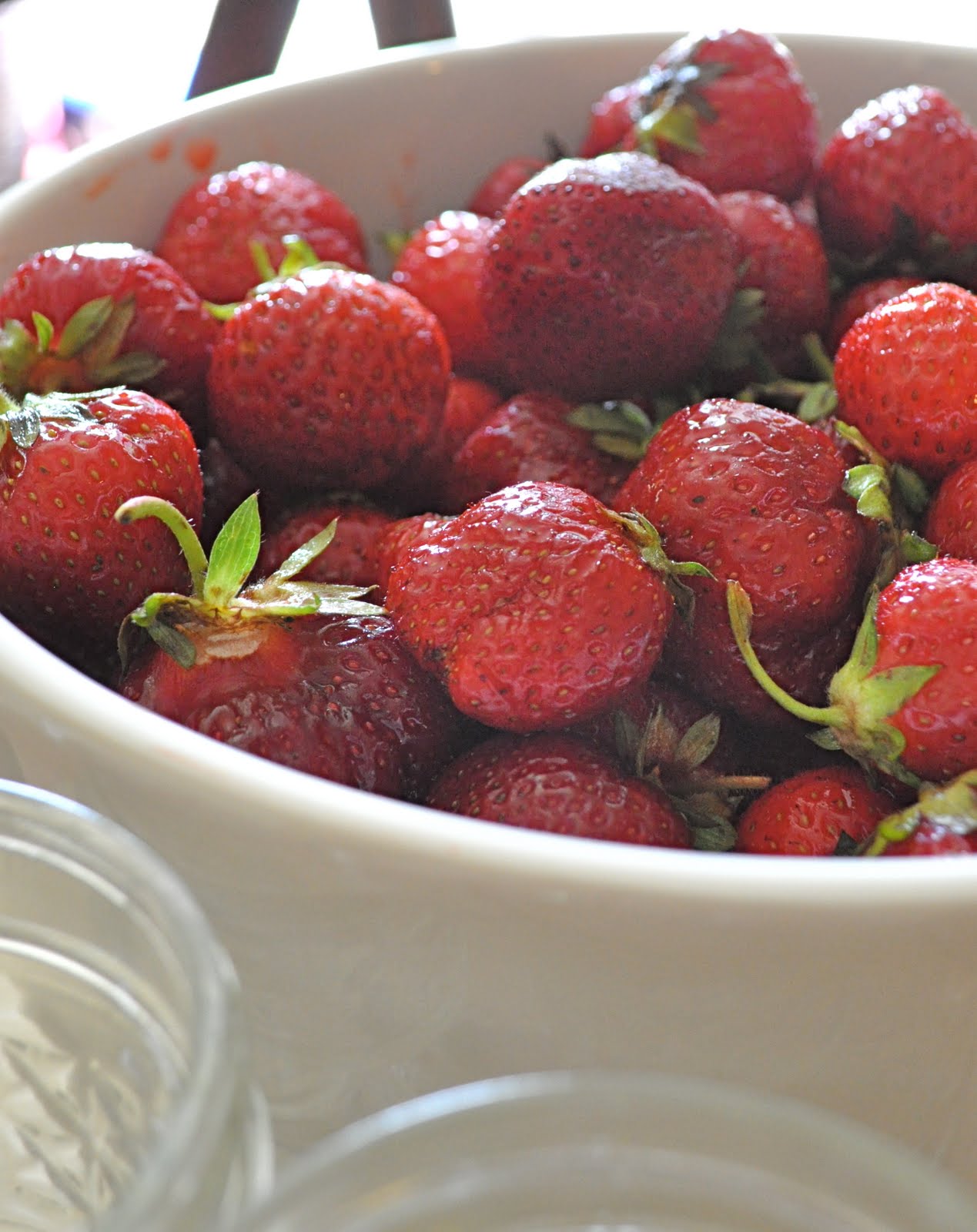
In Chicago, it's a fleeting strawberry season. In fact, so quick that it's only around for two weeks before the peaches move in and reign. This is the time of year when the berries have that full, sweet, "real" strawberry taste, and not that bland, disappointing, dense nothingness when they are out of season.


Even though I've made freezer jam;I wanted to make strawberry syrup. My kids love that crappy, junky goop in a squeeze bottle that is stirred into milk and I wanted something natural that they could put in instead. I must admit, 2 tablespoons in milk is pure heaven.
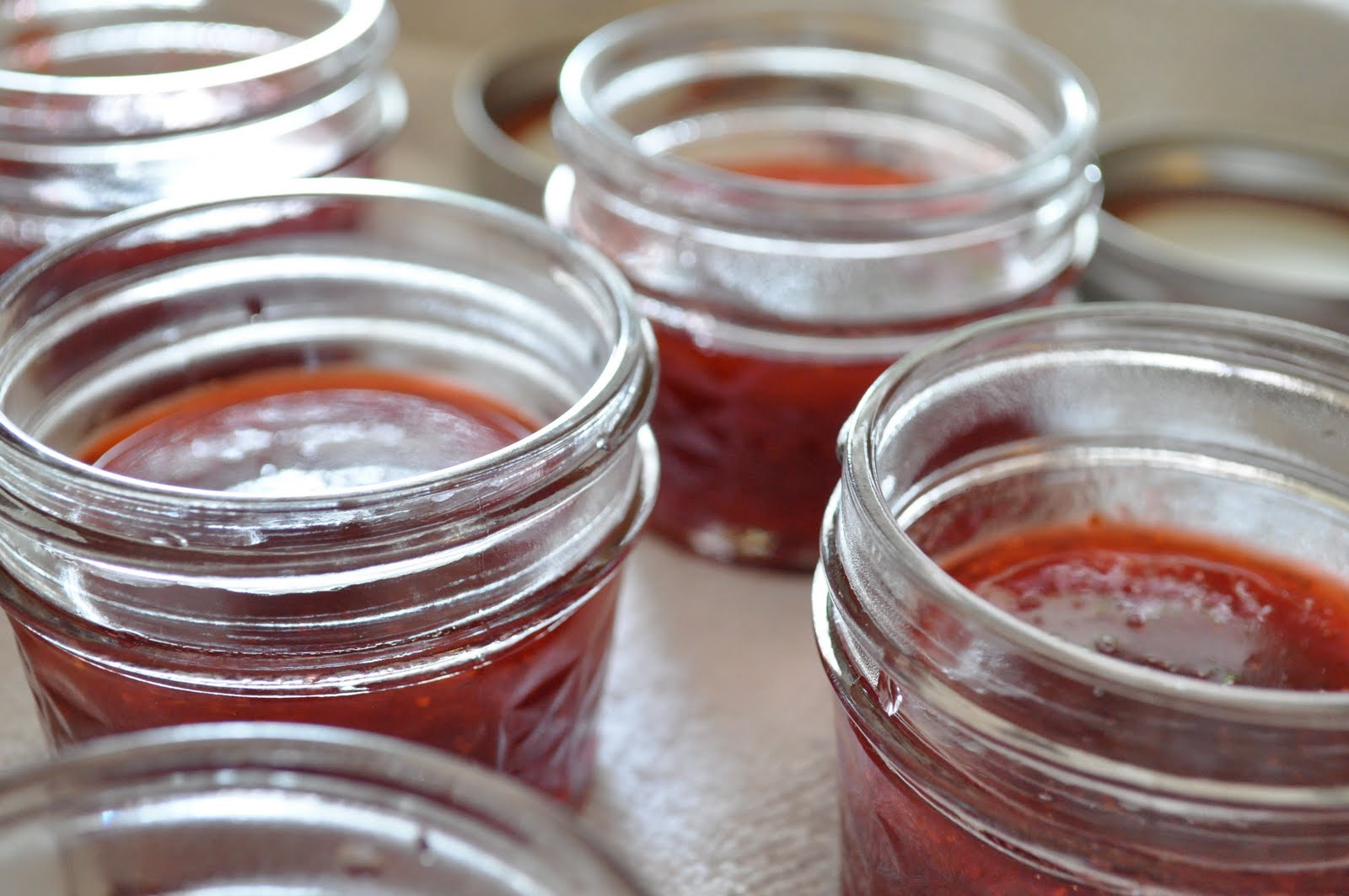
I love this syrup recipe. It can even be poured over ice cream, pancakes, almost anything, and I keep it in my deep freeze in little freezer-safe canning jars to have summer memories all through the dark winter months.


All you need is 2 cups crushed, hulled strawberries ( I used a hand blender.)
(After you puree it, you can run it through a sieve to get the pulp and seeds out.We don't mind it and I am lazy, so I left mine in.)
1- 1/4 to 1 1/2 cups sugar depending on how sweet the berries are.
1/4 teaspoon fresh squeezed lemon juice.

Put the puree and the other ingredients in a sauce pan and cook it over low heat, stir until the sugar melts.
Bring it up to a boil over medium-high heat. Once it comes to a boil, simmer over low. Skim the foam from the top. Save it though! You can still use it!
(Be careful on the stove not to splash, because it's basically a boiled syrup and burns can be bad.)


This recipe made enough to fill 8 of those mini-canning jars. Let cool, pour in, put the lids on and keep in the freezer for up to 1 year or the fridge for 3 weeks. So easy!
Take the left-over stuff you skimmed and give it a quick 30-40 second zap in the microwave, making sure it doesn't boil over and let it cool before handling. The foam will settle and there will be much less to skim off and less syrup wasted. You'll end up with almost one extra jar.


Eat that one first, and then enjoy the fresh, sweet summer taste all year 'round.

: ) Jen

Sunday, June 20, 2010

In the garden....Late June

 I have been battling the black ants for these beauties; super sweet, Fall Gold raspberries. Those ants suck just enough to start a bit of mold on each berry with all of the rain we have been having.


I finally decided to put a small bowl of sugar water out and am moving it away slowly, a bit farther each day. They, of course, don't even bother the tarter Red Heritage variety. Damn ants.

I'll let you know if it attracts them away, or just brings more ants to the party.
The good news is is last year we put a biological nematode control for grubs and this year , so far, knock on wood, I've seen hardly any Japanese Beetles. I'll have to let you know farther into July if it's a fluke or if it really worked.


I have no clue what this is. It's a weed that sprouted in my yard and I thought it was too pretty to pull. There are a few of them. It's about 3 feet tall with what almost looks like a pink grain with a leaf with a ruffled edge. Any ideas?


The corn is definitely knee high. And the soybeans and squash are slowly filling in too.


My potatoes are finally blooming and the new potatoes will... umm should, be ready to dig out soon. Though I will admit, I tried to find some today to cheat a bit and I couldn't find any. They are either still really tiny, or really deep. Damn potatoes.

I also cut some lavender today. I am going to make lavender sugar once it dries.


And I have this rambling mystery vine happily growing from my compost pile. I am pretty sure it is from last years pumpkins. I think so. I hope so. Otherwise, It might be a bit scary.

Tuesday, June 1, 2010

Jen's Organic Chocolate Chip Cookies...


I was tired of all of the extra junk in fun foods.
Why can't fun foods be good? So when I stuff my face with 3 a day I don't have to feel guilty?
I have to admit. I loooooooove my sweets. This recipe came about after tweaking and trying and realizing my store bought cookies, as sad as it is, were really bad for me.


I promise you'll love it and it's yummy enough and good enough to eat for breakfast sometimes (Did I say that out loud?). Your kids will never know it has whole wheat. Plus chocolate comes from a tree so technically, it's a fruit.
I prefer to use almost all-organic ingredients. The only non-organic part is the chocolate chips and the vanilla. You can also make this with conventional ingredients with no problem.


Preheat oven to 375 degrees.

3/4 cup white sugar
3/4 cup packed brown sugar
1 cup extra virgin olive oil ( yep EVOO)
1 tsp vanilla
2 large eggs
3/4cup whole wheat flour
1 1/4 cup white flour
3/4 tsp salt
1 package (12 ounces) semisweet chocolate chips.

I'm lazy
I forgo the traditional creaming and throw it all in a bowl together as I assemble it.
It will be a bit wetter than regular cookie dough, but you need it for the whole wheat part.

Spoon it onto baking sheets in a with a teaspoon and bake for about 10-12 minutes. Since it has whole wheat you don't want it dark brown because they will be dried out.
A very light golden brown is perfect.

Let cool.

To keep them fresh in your cookie jar, throw a piece of bread in there. It really works to soften your cookies.

Then enjoy.. for breakfast. :)

Tuesday, May 18, 2010

Grow potatoes


My grandmother had always grown and stored her own potatoes, but I never realized there was more to it than just plopping them in the ground.

While you can grow them in a container or in the ground, dirt or straw, I like the ground in the dirt, it give bigger yields. Even though it takes up more space, I like the sensation of getting in the soil and pulling out a bit of buried treasure.

You start with these little cutie's , either
a whole certified seed potato , cut into 3 or four chunks with an "eye" each, or you can buy "sets" already cut and ready to plant from a mail order catalog, on-line or nursery. Potatoes from the grocery store have growth retardants sprayed on them so they may not sprout for you correctly.

If you decide to cut your own from a whole potato, cut them into 3 or 4 pieces each with an "eye". Let them sit on your garage for a few days exposed to air so they scab over. They will look moldy and gross; but they are perfect for planting.

Put them in the ground a few inches down and cover them with soil. I put the "eye" sideways. Put a stick in where the potato is so you can remember and don't dig it up by accident.

As it comes out of the ground it will resemble tomato leaves a bit. as the plant grows, you want to mound the soil up around the stem, probably about once a week depending on how fast they grow so only about 6 inches is above the ground. This keeps the potatoes out of the sun. Potatoes exposed to sunlight become green and bitter and toxic. Never eat green or bitter tasting potatoes. This can happen in the grocery store too, so the same goes for them as well.

My friend ,Manuela ,helped me to take the spud plunge with her great advice.
I imagined organic, fresh, white, creamy, fluffy mashed mounds at Thanksgiving.
Two years ago, this was my entire potato harvest...

I mean my lame harvest. I planted after July, Waaay too late. For best results, plant them as early as possible, In Illinois I put mine in this year in late April.

As they grow you mound and they become sprawling. Some will develop seeds which looks like mini-green tomatos. Never eat these, they are extremely toxic with high contents of solanine. I cut them off right away so my kids don't get a hold of them.

After the plants flower, you can " carefully" dig for new potatoes , you know, those expensive gourmet kind. You want to be extremely careful not to scratch other potatoes you aren't digging up . The skin is very fragile. Cover back up the rest of the potatoes until you are ready to harvest them again.
Last year, when I stared digging, I wasn't sure what I was going to get after the previous year's harvest..

It was kind of like a treasure hunt. But, I had images of last years results and didn't set my hopes too high...and then....

Hey! Look at that! Holy cow! Is that what I think it is?! A real potato! My neighbors probably thought I'd lost it the way I whooped and hollered; it was like I had never seen a potato before.
I squealed every time one came out of the ground.

I ran in the house with a bowlful yelling "Look! Look!I grew these! Real potatoes! From our garden! How awesome is this?!"
My hubby looked at me for a minute,
and then I think he rolled his eyes.

Who can blame the guy?
All that for a root vegetable. Imagine if I had won a million dollars?

I had 4 plants and probably got about 6-8 potatoes per plant. This year I planted Russett and Yukon Gold varieties.

The full size potatoes are ready to harvest about 2-3 weeks after the tops die back. Brush off any dirt, but do not wash. Store in a cool, dark place until ready to eat.


Jen

Monday, April 26, 2010

growing asparagus.


Our little asparagus patch has finally produced enough spears for a family meal!
There's nothing like the first vegetable of the spring!

I put in more crowns (roots) last year, and
I am putting in more crowns this year in hopes
that over the next few years that we'll get enough for several meals.
Some places say to harvest after the second year, some after the third. The best rule I've heard is don't harvest anything smaller than your pinkie finger the first two years.

There are several varieties you can plant. Actually put in ones that my local grocery store had. Some are more resistant to damage and disease than others, so check in your area to see what is available.

For a decent patch I would estimate you would need about 12 -15 crowns. and then wait 3 years.


Anything smaller you have to leave to mature for the following year.
This is my fourth year for my first patch, so I should get almost 6 weeks of picking.

I don't have any pictures, but if you let a spear go, it becomes a large feathery plant as a male or berries as a female. After it feathers and berries, it becomes inedible, mildly toxic and can even be a skin irritant; but it protects the underlying shoots for the following year.
In the early, early spring, you cut back all of the dry foliage to the ground and get rid of it incase it has any beetle eggs.


As for the The beetles, I just hand-pick and put them into soapy water.

There are two kinds of Asparagus beetles you can get. Even though a lot of sites recommend spraying, I never spray. I just pick into soapy water and if I see the feathery branches with eggs, I strip them off them. I do ware gloves though because the larvae can be a bit squishy. It's gross.

One thing I didn't know is that even thought they are the first veggies up in the summer; they can still get ruined by the frost ( you can tell by their bendiness and translucency.). So after those first shoots come poking out of the ground, cover them with a towel every night until your frost date has passed.
To pick, I prefer to snap mine off at the ground, then you don't accidentally cut the other emerging spears.

When you find it starts coming in a spear here and there, but not enough for a meal; I pick the ones that are ready over 2 or 3 days and keep them in the fridge in a glass with a bit of water at their feet. This way they will stay fresh until you are ready to eat them.

If you have any patience, it's well worth it. Fresh asparagus from your yard is nothing like what comes from in the store.


*image from gardengate magazine


Tuesday, April 13, 2010

grass-fed beef.

My oldest took a car ride with me on Saturday. We were going to get our grass-fed beef. I didn't think much about it until she asked me why we were buying our meat off of the back of a refrigerated truck in a church parking lot instead of the store. I have to be honest, it felt a bit clandestine.
I found the company through a good friend of mine who found them through eatwild.com.
I wanted to try it because my cholesterol hovers just around borderline, and my dad died at 52 from heart disease that was diagnosed at 42 ( just around the corner for me.). I had read that grass-fed beef has higher CLA and extra omega-3's that have a cholesterol lowering effect that traditional grain fed beef does not have.

I have to admit. There is something that scares me deep down inside about our food. I know my husband thinks that I've gone over the edge; but I am seeing a world that is evolving into a place where some of the most natural and good things that go into our bodies aren't so pure and honest any more. I am afraid of the long term effects of GMO's and pesticides and all of the other junk. It has actually probably made me a little nuts.

So now I am buying my meat out of a truck.

But I was thinking about it and with this and the CSA we do every year, maybe it's good that my daughter can see that food comes from somewhere other than the glossy, shiny supermarket. That our food comes from the ground.
Even our own garden.
Our own hands.

Maybe these last 50 years of bigger, better, smaller, faster has pulled us away from our own right to be self-sufficient.

She asked me where the meat came from and I was trying very tenderly to explain about how they get the meat, and "dispatch" the animals, but she wanted details.

100 years ago on the farm it would have been a fact of life and I wouldn't have to find an uncomfortable way to gloss-over an important part of the farm to table process.

I don't want to do the dirty work per se, or be a vegetarian, but I want to have respect for where my food comes from, and I hope my children can learn the same thing.

Friday, April 2, 2010

Never gardened? Get started.

If you've always wanted to garden, and get back to more self-sufficient roots, it's as easy as just a few plants in limited space.

Green beans.
They grow fast. can be replanted through out the season and have high yields. They fix the ground with nitrogen which helps other plants like corn grow.
They are good companions for celery, cucumbers and corn. They are great for kid to grow too.
IF you don't want to worry about a trellis, then make sure you get a bush variety. You may need to chicken wire or fence of your patch too because bunnies looooooove them green beans.

Tomatoes.
Plant with Basil as a companion. Plant an indeterminate variety which keeps giving. Determinates ripen their crop all at once.
I love the green zebra heirloom variety. They have a fabulous flavor and those damn squirrels can't tell when they are ripe.
Plant them in a pot with organic garden soil (if you don't have space.) They like it hot, ho , hot last winter was terrible. I think I got eight from 3 plants!!

Cucumbers.

put them in, give them some water, watch them grow. Get the bush variety if you don't want to trellis them. Don't get the lemon heirloom variety. They are spiny and super seedy.

Picking your seeds

I try to get NON-GMO varieties. I don't want to eat frankenfood. I don't want my kids eating it.

If you want an eye-opening experience about GMO food, watch the Future of Food.

Thursday, April 1, 2010

What are GMO's? The scoop...The scary scoop

I have to apologize a head of time. This is a heady and heavy post and not so happy, but really important to me. I realize I might get some hate mail for this.

What are GMO's or Transgenic foods?

GMOs' are genetically modified food and to be honest, they scare the H-E-double hockey sticks out of me.

A corporation started making genetically modified food in the 1990's as a hopeful panacea of relief for starving nations and struggling farmer's.
First they made a potato modified with a BT gene. This seemed like a great thing because what ever ate the plant died as it's a normal soil dwelling bacterium. So cool! It's safe for humans and other creatures, but just kills off the pests.. great! But the farmer's still had to spray weed killer.
Then came the Round up Ready products ( corn and soybean).
The problem is is Round up (glycophosphate) is still a chemical. While it's technically "safer" for human's than DDT... I say safer, not safe.

In these new GM's is a gene to recognize and be resistant to round up, so a farmer could spray an entire field and the only weeds that would die would be the non-round up ones.
The problem is Round up gets into our water ways once it flushes throughout the ground and not only cannot be filtered out of our drinking water, and according to Mother Earth News, They cause a whole bunch of other medical problems. And now it is growing super weeds that are evolving and becoming resistant.

And then there's the whole antibiotic thing.

They have inserted into the genetic code an antibiotic resistant marker to make sure the gene is working. Is it a strange coincidence that antibiotic resistance is hot on our heels in the last 10 years when we started eating these products. and you are eating them. They are in up to 70% of our grocery store shelves under names like high fructose corn syrup, xanthan gum, corn syrup.


Then came the fact that farmer's could only buy this product from the corporation and were not allowed to save their seed. If a farmer who was growing a non-GMO product that cross pollinated from the wind was sued and lost because they were"stealing" the patent.

Here's the other problem. Right now it's in corn and soy.
Right now conventional Cattle and Chickens are being fed this GM products. So we get way more than double doses.
GM Wheat and beets are next. Supposedly they are now testing a product with a "kill switch" so the seeds are sterile and cannot be re-sewn, so the farmer has to buy new ones every year.
So, if the wind can carry and cross contaminate one thing, what happens to all of the other seeds in the world if it cross contaminates with this kill switch? Would we eventually have to clone all of our plants? Plus they have no idea what happens down the line if plants cross bread or how the DNA genes recombine.
They are even working in testing to make corn that is modified with a human gene. Super-gross.

DDT was once considered the safest pesticide on the planet. Kids would ride their bikes in the plumes behind the trucks.

And.. they don't know the real true effect on us from eating this stuff long term. It's genetic engineering.. how does it effect us long term? Can we all become antibiotic resistant? Infertile?
What are the long term effects. Some scientists are projecting an increase in stomach cancers at a young age.
It's almost like Kudzu. People who live in the south realize the effect of Kudzu. A "harmless"plant brought from Asia for ornamental purposes That has completely taken over and caused tons of damage.

The biggest questions.. who is affected first? The worst answer is...The ones with the littlest bodies, our kids.

GMO's right now are not required to be labeled on our food, but are required to be labeled in the U.K.

I realize this sounds very Sci-fi, but it's very true. I am no expert, and I know this might be upsetting to some people. My sources have been The Future of Food, Food inc, Mother Earth news, and research from information from the University of Florida web page. Please feel free to investigate it further and let me know if there is any other info on it. Google GMO's and transgenic foods.

So to make a long story short, Buy your seeds and food non- GMO.

Monday, March 29, 2010

Being green

I didn't start off as green person. I didn't start off eating organic. It started as a slow journey for me more than 15 years ago.

It has come for me in moments.

It came for me first at the moment when I was 23 and had a fasting cholesterol of 218 and it's been as high as 230. I've battled it every step of the way trying to avoid medication with diet and exercise.

The second set of "moments" were when my father died at 52. It was during surgery for a heart bypass due to peripheral vascular disease caused by high cholesterol, two months after my wedding. It was one of the most devastating moments of my life. My Aunt, his sister, had passed 7 years before at age 52 of a weird cancer they weren't even sure what it was. Then, my sister in law died at age 24 when my oldest was 1o months old, leaving behind 2 little girls, from a disease to this day they don't know what it was.
All of those losses were the hardest things I had ever been though,
and as a mother I knew I wanted to still be here at 52 for my kids, and hopefully, God-willing, they won't have to go through the pain of missing some one they loved so much.

So we started eating healthier and excersizing. I breast-fed after I read about the benefits. I stared looking into what was really healthy and what was not.

Then my middle child developed breathing issues and I wanted to make the house a better place to breathe and less toxic for her so we started with more natural, non-toxic, eco-friendly cleaners.

When I started reading about pesticides and I knew that they were meant to kill things, living things. With the way our family had weird things happened, I didn't want to take any chances. and I knew I didn't want any of that in my families bodies. We went with a organic lawn service at first and finally due cash flow, an organic lawn :) dandelions anyone?

It's been a slow transition for us, and a small price adjustment a bit at a time. It's expensive to eat organic, but to us it's worth it, and it's just such an individual life choice and style, that I hope eventually more people choose.

I've heard people say they think they are better of not knowing. Knowing opened my eyes to what is really going on with our food. I am glad I know.

Which led to us to buying more organic produce, and growing a lot of our own food in the summer months to offset the cost of winter buying. The sun, dirt and rain are free.

I was happy to see the moment after making the final switch to grass-fed beef and free range eggs this year, my total cholesterol went from 226 to 200. I was ecstatic. I haven't even been really exercising. So I know if I actually get my butt in gear, It would be even better. I don't know if it would work for everyone, but it made a huge change for me.

It was a great moment. And I hope it is followed by many more.
Way more than 52 years.